Sunday, April 10, 2016

Catherine Meadows Weekly Post 12


Avoid Highways


Okay so I absolutely love everything about this series. I was initially interested in looking at this series because I was curious of the title Avoid Highways.

So basically this series contains shots of sights that he saw while taking a road trip. When using his GPS, he chose the option "avoid highways" so that he had to take back roads to get to where he was going. By taking less common roads, he stumbled upon all these strange yet beautiful things.

Andrew Knapp is more commonly known for his "Find Momo" series, which is how I discovered him in the first place. In the Find Momo series, he travels all around the world with his dog, Momo, and takes beautiful photos with his dog hidden somewhere in it. Since starting this series, he's published two Find Momo books that are similar to the Where's Waldo books.

I chose the Avoid Highways series for my blog post because I loved the variety and oddness that it contained. It has a great concept behind it- the concept being to photograph what he saw when traveling on roads that are not commonly driven on. And the photographs themselves are beautiful in my opinion. With his portraits, he chooses to place the subject directly in the middle, which normally bugs me, but doesn't with this series. His inclusion of still lives and various landscape shots add to the oddity that I get from it. We would never see anything like a row of colored horse statues on any normal mapped out route, and that's really what I love most about this. I'd love to try this project over the summer sometime and photograph whatever I stumble upon.

Hailey Porth Weekly Post

Stefan Ruiz

Stefan Ruiz is a master at portrait photography he is able to capture incredible images of people that keeps the eye continuously stuck on the subject itself. The picture below to the left is a great example of that because of the simple background it moves me immediately to the subject and because the background is also light blue and then her shorts are a darker shade of blue it again brings my eyes to her because the contrast between her and everything else is so brilliant and then her start is absolutely astounding I feel like she is looking right at me and I am with her right now, it also reminds me of the "mom look" and connects her to my mother. However, because of her pink bows it gives me this idea that she is still living in the days of her youth which she had to miss out on. But this is just one example of the many pictures that Ruiz has shot.


His eye for color reminds me a lot of Saul Leiter's work. The picture below to be exact brought his photograph to mind. (The top is Ruiz the Bottom is Leiters) I think its the way they are both able to single out color and still capture impressive colors and still make it about the person being photograph blows my mind. They both are very simple in their work, and when I say that to the viewer it seems incredibly simple then when you start to look at the photograph you can see the intentionality and the purposeful decisions made.


Ruiz work is what I want to be working towards. After Our final critique I feel like I have found my groove of making portraits. After looking at his work I want to make sure that I am focusing on the simplistic aspect of my photographs as well as color. For a really long time I have had a problem with making a portrait and being like oh yeah that's what I want to do, I felt like I wanted to do something more, I know its dumb, but I am in this season where I really like making portraits and I am going to work really hard on them because it's something that I enjoy and I know wI can put a lot of effort into them right and learn so much!


Rachel Trautmann's Weekly Post 04/11/16


 Ricardo is a professional photographer that solely works in architectural photography. He discovered his love for photography at a young age but decided to attend school for architecture. After working national and international as an architect for 10 years, he decided to focus his energy on photographing the buildings he loved. In 2010 he launched his photography company, Ricardo Oliveira Alves Photography. He currently photographs very high-end and unusual properties created by some of the most respected architectural studios in the world.


Since I do a lot of property photography with my company, I thought including a photographer that has most of their focus on property photography would be interesting to do. Ricardo was an easy selection for me because of his wonderful collection of work. Beyond his wonderful framing and use of the angles created within these properties, I was drawn to his use of people within some of the properties he has photographed. I have never come across a architectural photographer that actually wants people in their shot.


Clearly, the man does amazing work. He uses the angles of the unique properties to his advantage. He also likes to photograph areas of the house that people may not experience otherwise; the sense of looking directly up at ceiling details, for example. The most unusual accent to his work is the use of people without his shots. The people add an interesting and more editorial feel to the images. It also creates images for people who may not be interested in architecture but are more drawn to an interesting image. The people within his frames are sometimes shown with motion blur but they can also be seen in very realistic setup for how the space would be used. However, like the image above, he also likes to use them for a bizarre twist on an image.


Kerry Kilburn Weekly Artist Post 4/11/2016

Gisela Erlacher
Interview in uncube magazine


From "assemble"

From "assemble"

From "Skies of Concrete"

From "Skies of Concrete"

Geisela Erlach is a Viennese architecture photographer who, according to an interview in uncube magazine, tends "to seek out the wild, the unplanned, and the accidental in the more or less consciously designed urban environment - and the absurd potential within such situations." Ms. Erlach studied psychology before earning a degree in cinematography from the University of Music and Performing Arts in Vienna. She has been a freelance photographer since 1992, and her work has been featured in shows as well as in museums, galleries, and private collections. She uses both a digital medium-format and film 4x5" camera for her work.

Her best-known work is her 2015 series, "Skies of Concrete," which has been published as a book (you can read a blurb about it here). She began the series in 2011 after noticing a house crammed between supports of a bridge spanning the Danube. She proceeded to travel to countries around the world, exploring similarities and differences in how people in different countries and types of landscapes used these "non-spaces," while cars and pedestrians passed unseen overhead, disconnected from what was happening on the ground below. I find these images very compelling, both for their formal qualities of line and shape, but also because of the strange juxtapositions between the massive, almost superhuman concrete structures and the smaller, human-scaled objects found beneath them. I love finding these kinds of juxtapositions myself, although I usually look for clashes between natural and anthropogenic objects and settings.

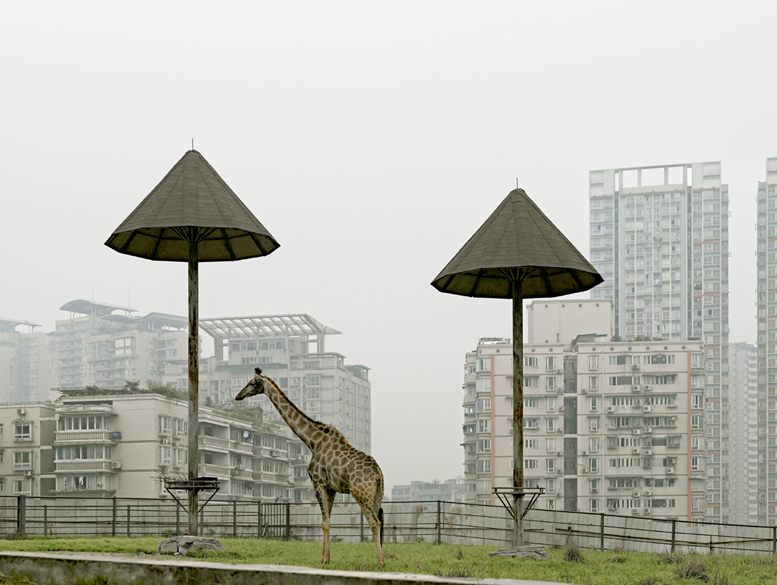
I included the images from her series "assemble" because I think they also exemplify her interest in the "accidental" and "absurd" within designed environments. What could be more absurd than a giraffe standing casually in front of skyscrapers under construction in the first photograph, and what could be a happier accident than the contrast between the intimacy of the clothing on the lines and the massive structures behind them in the second? Contrast, accident, and juxtaposition make me really happy, and I'm so glad I found Ms. Erlach!


Saturday, April 9, 2016

Anna Luker Blog


Ben Hopper


A London based photographer, probably best known for his 'Natural Beauty' series is a well rounded artist, photographer, and filmmaker. His main subject of works surround circus artists, dancers, and nudists. Ben was born on April 13, 1982 and currently is living and working in London, UK.

Some of his photography work has been featured in BuzzFeed, Cosmopolitan, ELLE (France), Glamour, The Huffington Post, and Yahoo just to name a few.  


Here is an excerpt from Ben's Blog that I think everyone might find interesting. 

"Let´s talk about your project 'Natural Beauty'. “I don’t want to say that I want women to start growing their armpit hair. I just think that it’s a possibility and people shouldn’t dismiss it. I’d like people to just question [beauty standards], the whole thing.” Is your quote out of an interview with the Huffington Post, that summarizes pretty well what your intention is. You got a lot of attention for it – how about criticism?
The project received a lot of attention and a good chunk of it was criticism.
A lot of it circulated around integrity. It’s a very sensitive issue and I think the virality of the project was due to the fact that everyone had something to say about it whether they agreed or disagreed with it.
Overall my intention with the project was a good one. It made people a bit more aware and perhaps accepting. I think it made a good change. "


His photography influenced a lot of positive things. Madonna and Miley Cyrus picked up and made it a trendy thing. Not that women haven't already just accepted their body for what it is, such as Frida Kalo, but the reach and influence celebrities have on society is far greater than most artists will see in their lifetimes unfortunately. 


A piece from another one of his projects, "Transfiguration." 

Hopper strips all material items and distractions from the subject so the viewer gets a more raw or authentic feeling. All photographs main focus in the females hair, specifically the armpit hair. The positions of the body of the subjects are posed in a little sexualized manner and the eye contact with the camera adds to that. The gaze combined with the almost see-through tanks, "by revealing one of the most feminine and arousing body parts in combination with a stereo-typically masculine attribute, Hopper jolts the viewer into confronting preconceived beauty ideals."


Miss Anele (#3) For Naked Girls with Masks 

This photo for me speaks volumes. The direction I hope to take in my final is probably going to be geared more towards gender roles and expectations. Which I find a very prominent in this photograph. The decision to wear a male mask. The humor in the surrounding environment with the cup. The fact she is naked. The first thing that came to my mind is the whole glass ceiling for woman. High ranking woman in power of companies or anything really face some negative humor and discrimination. "Did you sleep with your boss for that position?" "Who did you have sex with to get that job?" Just snarky comments like that. 


Friday, April 8, 2016

victoria garnett, artist post, 4/11/2016

charlie waite


I'm trying to get back into my nature/ landscape photography and I've been looking for photographers for inspiration. I stumbled across Charlie Waite.  His photographs are so direct. He focuses his camera directly on the section of the photo we should be looking at and not having our eyes wondering around the photo. In my opinion the last photo is simple yet very well constructed and beautiful.  He gives us beauty and mystery in these photos.I want to make photos such as these where I narrow down what exactly it is that want to photograph and not try and capture everything in one shot. According to his website, "Waite has given and continues to give tuition to amateur, professional and aspiring photographers of all ages from the UK, Australia, Europe, and the US which he hugely enjoys". 


Monday, April 4, 2016

Yajaida, 12

Martin Parr


 Internationally renowned street photographer, photojournalist, fashion photographer, and documentarian Marin Parr has published over fifty photo books and toured extensively. Born in Brittan, he studied photography at university. He is also a photobook collector and critic creating a three part series entitled "The Photobook: A History."

Starting in black and white, he has come to be known largely for his very colorful work. Similarly his equiptment usage has evolved. He began using a Leicia M3, moved to a Nikon 35mm and in 2006 he began to use digital, now a Canon enthusiast. Much of his work uses multiple flashes.

Taken from Parr's website intro, his images "show us in a penetrating way how we live, how we present ourselves to others, and what we value." The reason I chose this photographer is that his intent (though not all his style choices) was what I initially set out as my goal for this project. I wanted to do something that showcased our perception, presentation, and excess. But as I continue to work on this project, I get further away from my initial intent. To change isn't a bad thing, but I can't continue to wander aimlessly. So, I'm assessing again what I want to say so that I can compare it to what I have and then hopefully find my way again.